
Introduction
Dogs are among the most beloved and popular pets worldwide. Known for their loyalty, intelligence, companionship, and protective instincts, dogs have been part of human life for thousands of years. However, not all dogs are the same. Different dog breeds have unique physical characteristics, temperaments, activity levels, grooming requirements, and health needs. Understanding these differences is essential when choosing a dog that fits your lifestyle, family, and living environment.
Whether you are looking for a friendly family companion, an intelligent working dog, a small apartment-friendly pet, or an energetic outdoor partner, there are hundreds of dog breeds to explore. Each breed has been developed for particular purposes, including hunting, herding, guarding, companionship, and sporting activities.
This comprehensive guide explores popular dog breeds, their characteristics, different breed categories, care requirements, and important factors to consider before bringing a dog home.
What Are Dog Breeds?
Dog breeds are distinct groups of domestic dogs that share inherited physical and behavioral characteristics. These characteristics are passed from one generation to another through selective breeding.
A dog breed may be identified by its size, coat type, body structure, temperament, intelligence, and natural abilities. For example, Golden Retrievers are widely recognized for their friendly personalities, while German Shepherds are known for their intelligence, confidence, and working abilities.
According to the American Kennel Club (AKC), recognized dog breeds are organized into different groups based on their original functions and characteristics.
Dog breeds generally fall into categories such as:
- Sporting dogs
- Working dogs
- Herding dogs
- Hound dogs
- Terrier dogs
- Toy dogs
- Non-sporting dogs
Each category includes breeds with different physical and behavioral traits.
Most Popular Dog Breeds Around the World

Some dog breeds have become especially popular because of their personalities, adaptability, intelligence, and suitability for family life.
Here are several well-known dog breeds and their defining characteristics.
1. Labrador Retriever
The Labrador Retriever is one of the most popular dog breeds in the world. Originally developed as a working and retrieving dog, this breed is widely appreciated for its friendly personality, intelligence, and affectionate nature.
Labradors are medium-to-large-sized dogs with muscular bodies, short coats, and strong swimming abilities. They commonly come in three colors: black, yellow, and chocolate.
Key Characteristics:
- Temperament: Friendly, outgoing, and affectionate.
- Size: Medium to large.
- Energy Level: High.
- Intelligence: Very high.
- Grooming: Moderate.
- Best For: Active families, outdoor enthusiasts, and first-time dog owners who can provide sufficient exercise.
Labradors need daily physical activity, mental stimulation, and consistent training. Their social nature makes them excellent companions for households that have enough time to interact with them.
2. German Shepherd
German Shepherds are highly intelligent, loyal, and versatile working dogs. Originally developed for herding sheep, they are now widely used in police work, military operations, search and rescue, and personal protection.
They have strong muscular bodies, pointed ears, and dense double coats. Their intelligence and ability to learn complex commands make them excellent working and training partners.
Key Characteristics:
- Temperament: Loyal, confident, and protective.
- Size: Large.
- Energy Level: High.
- Intelligence: Very high.
- Grooming: Moderate to high.
- Best For: Experienced owners, active families, and working environments.
German Shepherds require early socialization, structured training, regular exercise, and meaningful mental activities.
3. Golden Retriever
Golden Retrievers are famous for their gentle temperament, beautiful golden coats, and friendly personalities. They are commonly considered excellent family dogs because they generally enjoy human interaction and are highly trainable.
This breed is intelligent, patient, and affectionate, making it suitable for families with children when properly supervised.
Key Characteristics:
- Temperament: Gentle, friendly, and social.
- Size: Medium to large.
- Energy Level: High.
- Intelligence: High.
- Grooming: Regular brushing.
- Best For: Families, active individuals, and people seeking an affectionate companion.
Golden Retrievers benefit from regular exercise, coat maintenance, and positive reinforcement training.
4. French Bulldog
French Bulldogs are small, muscular dogs recognized by their distinctive bat-like ears, short muzzles, and compact bodies. They are popular among people living in apartments because they generally require less exercise than many larger working breeds.
They are affectionate, playful, and often enjoy spending time with their owners.
Key Characteristics:
- Temperament: Affectionate, playful, and adaptable.
- Size: Small.
- Energy Level: Low to moderate.
- Intelligence: Moderate.
- Grooming: Low.
- Best For: Apartment residents and individuals seeking a companion dog.
However, French Bulldogs are brachycephalic, meaning their short facial structure can cause breathing difficulties. They are also vulnerable to overheating, so owners must take special care in warm weather.
5. Poodle
Poodles are intelligent, elegant, and highly trainable dogs. They come in three main sizes: Standard, Miniature, and Toy.
Their curly coats are often described as low-shedding, although they require regular grooming and maintenance.
Poodles are excellent at learning commands, participating in dog sports, and adapting to different household environments.
Key Characteristics:
- Temperament: Intelligent, active, and affectionate.
- Size: Standard, Miniature, and Toy.
- Energy Level: Moderate to high.
- Intelligence: Very high.
- Grooming: High.
- Best For: Families and individuals who enjoy training and grooming their pets.
6. Beagle
Beagles are small-to-medium-sized scent hounds originally developed for hunting. They have excellent smelling abilities, expressive eyes, and a friendly personality.
Their playful and curious nature makes them entertaining companions, although their strong hunting instincts can sometimes make training challenging.
Key Characteristics:
- Temperament: Curious, cheerful, and friendly.
- Size: Small to medium.
- Energy Level: High.
- Intelligence: High.
- Grooming: Low to moderate.
- Best For: Active families and people who enjoy outdoor activities.
Beagles need regular exercise and secure outdoor spaces because they may follow interesting scents.
7. Bulldog
Bulldogs are recognizable by their muscular bodies, broad shoulders, wrinkled faces, and distinctive appearance.
They are generally calm and affectionate companions. Although they may not require as much exercise as high-energy breeds, their health and weight need careful management.
Key Characteristics:
- Temperament: Calm, affectionate, and courageous.
- Size: Medium.
- Energy Level: Low.
- Intelligence: Moderate.
- Grooming: Low to moderate.
- Best For: Households seeking a relaxed companion.
Like French Bulldogs, English Bulldogs have brachycephalic facial structures and may experience breathing and heat-related health problems.
8. Siberian Husky
Siberian Huskies are athletic working dogs originally bred for pulling sleds in cold environments. They are known for their striking appearance, thick double coats, erect ears, and often blue or multi-colored eyes.
Huskies are energetic, independent, and social dogs that require plenty of exercise.
Key Characteristics:
- Temperament: Friendly, energetic, and independent.
- Size: Medium.
- Energy Level: Very high.
- Intelligence: High.
- Grooming: Moderate to high.
- Best For: Active owners and households with plenty of space and time for exercise.
Huskies are not ideal for owners who cannot provide regular physical activity and mental stimulation.
Different Types of Dog Breeds
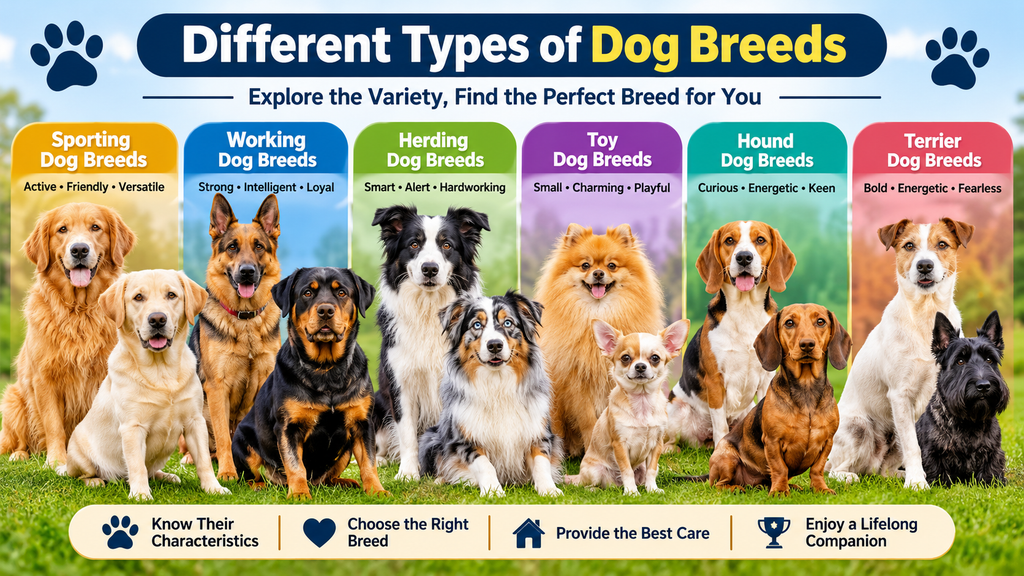
Understanding dog breed categories can make it easier to identify which type of dog matches your needs.
Sporting Dog Breeds
Sporting dogs were traditionally developed to assist hunters in locating and retrieving game. They are generally energetic, intelligent, and responsive to training.
Popular sporting breeds include:
- Labrador Retriever
- Golden Retriever
- English Springer Spaniel
- Cocker Spaniel
- German Shorthaired Pointer
These breeds usually perform best with regular exercise, outdoor activities, and interactive training.
Working Dog Breeds
Working dogs were developed to perform demanding tasks such as guarding property, pulling loads, and assisting humans.
Examples include:
- German Shepherd
- Rottweiler
- Doberman Pinscher
- Boxer
- Siberian Husky
Working breeds often need experienced handling, consistent training, and adequate physical activity.
Herding Dog Breeds
Herding dogs have traditionally helped farmers manage livestock. They are known for their intelligence, responsiveness, and ability to follow complex commands.
Popular herding breeds include:
- Border Collie
- Australian Shepherd
- Belgian Malinois
- Pembroke Welsh Corgi
- Shetland Sheepdog
These breeds often need more mental stimulation than a simple daily walk can provide.
Toy Dog Breeds
Toy breeds are generally small dogs developed primarily for companionship. Their compact size makes many of them suitable for smaller homes and apartments.
Examples include:
- Chihuahua
- Pomeranian
- Yorkshire Terrier
- Maltese
- Shih Tzu
Although small in size, toy breeds still require training, socialization, exercise, and proper veterinary care.
Hound Dog Breeds
Hounds are traditionally known for their hunting abilities. Some rely primarily on their sense of smell, while others use their eyesight and speed.
Popular hound breeds include:
- Beagle
- Greyhound
- Dachshund
- Basset Hound
- Bloodhound
Their instincts can influence their behavior, so secure environments and appropriate training are important.
Best Dog Breeds for Families
Choosing a family dog requires careful consideration of temperament, size, energy levels, and compatibility with children.
Some breeds commonly considered for family households include:
Golden Retriever: Known for its affectionate and generally gentle personality.
Labrador Retriever: Social, energetic, and highly trainable.
Beagle: Playful and curious, with a strong interest in exploration.
Poodle: Intelligent and adaptable, with several size options.
Cavalier King Charles Spaniel: Affectionate and generally well suited to companionship.
However, no breed is automatically perfect for every family. Individual temperament, training, socialization, and supervision are equally important. Children should always be taught how to interact safely and respectfully with dogs.
Best Small Dog Breeds for Apartment Living
People living in apartments often prefer dogs that can adapt to smaller indoor spaces.
Some popular small dog breeds include:
- French Bulldog
- Pomeranian
- Chihuahua
- Shih Tzu
- Maltese
- Yorkshire Terrier
When choosing an apartment-friendly dog, consider barking tendencies, exercise requirements, grooming needs, and the dog’s ability to remain comfortable when alone.
A small dog does not necessarily mean a low-maintenance dog. For example, some small breeds need substantial grooming, training, and mental stimulation.
How to Choose the Right Dog Breed

Selecting the right dog breed is an important long-term decision. Before bringing a dog home, evaluate your lifestyle, household environment, and ability to meet its needs.
1. Consider Your Living Space
Your home environment can influence which dog breed is suitable. Large and energetic breeds may need more room and outdoor activity, while some smaller companion breeds can adapt more easily to apartment living.
However, exercise requirements matter more than size alone.
2. Evaluate Your Activity Level
If you enjoy running, hiking, or outdoor adventures, an energetic breed such as a Labrador Retriever or Australian Shepherd may be worth considering.
If you prefer a quieter lifestyle, a lower-energy companion breed may be more appropriate.
3. Understand Grooming Requirements
Different dog breeds have different coat maintenance needs.
Long-haired breeds such as Shih Tzus and Golden Retrievers require regular brushing. Poodles need professional-style coat maintenance, while short-haired breeds may require less brushing.
4. Consider Training and Experience
Some breeds are easier for first-time owners to manage, while others require experienced handling.
Dogs such as Border Collies and Belgian Malinois need significant mental stimulation, structured training, and consistent activities.
5. Review Health Considerations
Every breed has potential inherited health concerns. For example, large breeds may be predisposed to certain joint conditions, while flat-faced breeds can experience respiratory problems.
Before adopting or purchasing a dog, research breed-related health risks and request appropriate veterinary health records.
Dog Grooming, Nutrition, and General Care
Regardless of breed, every dog needs proper nutrition, exercise, grooming, and preventive veterinary care.
Nutrition: Feed your dog a complete and balanced diet appropriate for its age, size, activity level, and health requirements. Puppies, adults, and senior dogs may need different nutritional formulations.
Exercise: Provide physical activity according to your dog’s age, breed characteristics, and health. Daily walks, interactive games, and training sessions can support physical and mental well-being.
Grooming: Brush the coat regularly, maintain nail length, clean ears when appropriate, and establish a consistent dental care routine.
Veterinary Care: Schedule routine veterinary examinations, vaccinations, parasite prevention, and dental assessments. Seek professional advice whenever you notice unusual behavior or physical symptoms.
Socialization: Introduce dogs gradually and positively to different people, environments, sounds, and other animals. Early socialization can help develop confidence and appropriate behavior.
Purebred Dogs vs. Mixed-Breed Dogs
One common question among prospective owners is whether to choose a purebred dog or a mixed-breed dog.
Purebred dogs generally have more predictable physical and behavioral characteristics because they come from established breeding lines. However, some purebred populations have increased risks of inherited conditions due to limited genetic diversity or breed-specific physical traits.
Mixed-breed dogs have ancestry from multiple breeds. Their appearance, size, temperament, and health characteristics can be less predictable.
Neither option is automatically healthier or better. Responsible breeding, genetic background, veterinary care, early experiences, and individual temperament all matter.
Adoption from reputable animal shelters and rescue organizations is another excellent way to find a companion.
Frequently Asked Questions About Dog Breeds
What are the most popular dog breeds?
Some widely popular dog breeds include Labrador Retrievers, Golden Retrievers, German Shepherds, French Bulldogs, Poodles, Beagles, and Bulldogs. Popularity varies by country and registration organization.
Which dog breed is best for families?
Golden Retrievers and Labrador Retrievers are commonly considered family-friendly breeds because of their social and affectionate personalities. However, individual temperament, training, and supervision are important.
Which dog breeds are best for apartments?
French Bulldogs, Chihuahuas, Shih Tzus, Maltese, and some other small companion breeds can adapt well to apartment living. Their exercise, noise, and grooming requirements should still be considered.
What is the most intelligent dog breed?
Border Collies are frequently ranked among the most intelligent dog breeds, particularly for learning commands and performing complex working tasks. Poodles and German Shepherds are also highly intelligent.
Which dog breeds require the least grooming?
Short-coated breeds such as Beagles, Boxers, and some other smooth-coated dogs generally require less coat maintenance than long-haired or continuously growing-coated breeds. All dogs still need basic hygiene and regular care.
Are large dog breeds suitable for first-time owners?
Some large breeds, including Labrador Retrievers and Golden Retrievers, can be suitable for responsible first-time owners who are prepared to provide training, exercise, and veterinary care. Size alone does not determine suitability.
How many dog breeds exist?
There are hundreds of recognized dog breeds worldwide. The exact number depends on the kennel club or canine organization because different organizations recognize different breeds.
Should I adopt a dog or buy a purebred puppy?
Both adoption and responsible purchasing can be appropriate choices. Adoption provides homes to dogs in need, while responsible breeders should provide health information, appropriate genetic testing, and suitable early care.
Conclusion
Choosing from the many available dog breeds requires more than simply selecting a dog based on appearance or popularity. Every breed has its own personality, exercise requirements, grooming needs, health considerations, and training characteristics.
Labrador Retrievers and Golden Retrievers are popular choices for active families, German Shepherds are recognized for their working abilities, Poodles are valued for their intelligence, and smaller companion breeds may suit people living in apartments.